Online retail saltwater and freshwater aquarium fish direct from Matt Pedersen via MiniWaters.FISH – shop online now!
Since the Lightning Project started, and particularly once progeny first became available, I’ve had countless inquiries about purchasing Lightning Maroon Clownfish direct from me. In 2013 and 2014, all the offspring I had to offer were sold exclusively through Blue Zoo Aquatics and the team there. 2015 saw a dramatic uptick in production and availability from Sea & Reef Aquaculture; meanwhile for multiple reasons I don’t think I reared a single fish in 2015.
However, the holdback pair, MD1 and MD2, started spawning for my good friend Mike Doty, and thus, we’ve had F2 fish available as I announced late last year. There are also very limited F1 Lighting Maroon offspring straight from the wild pair that I will make available.
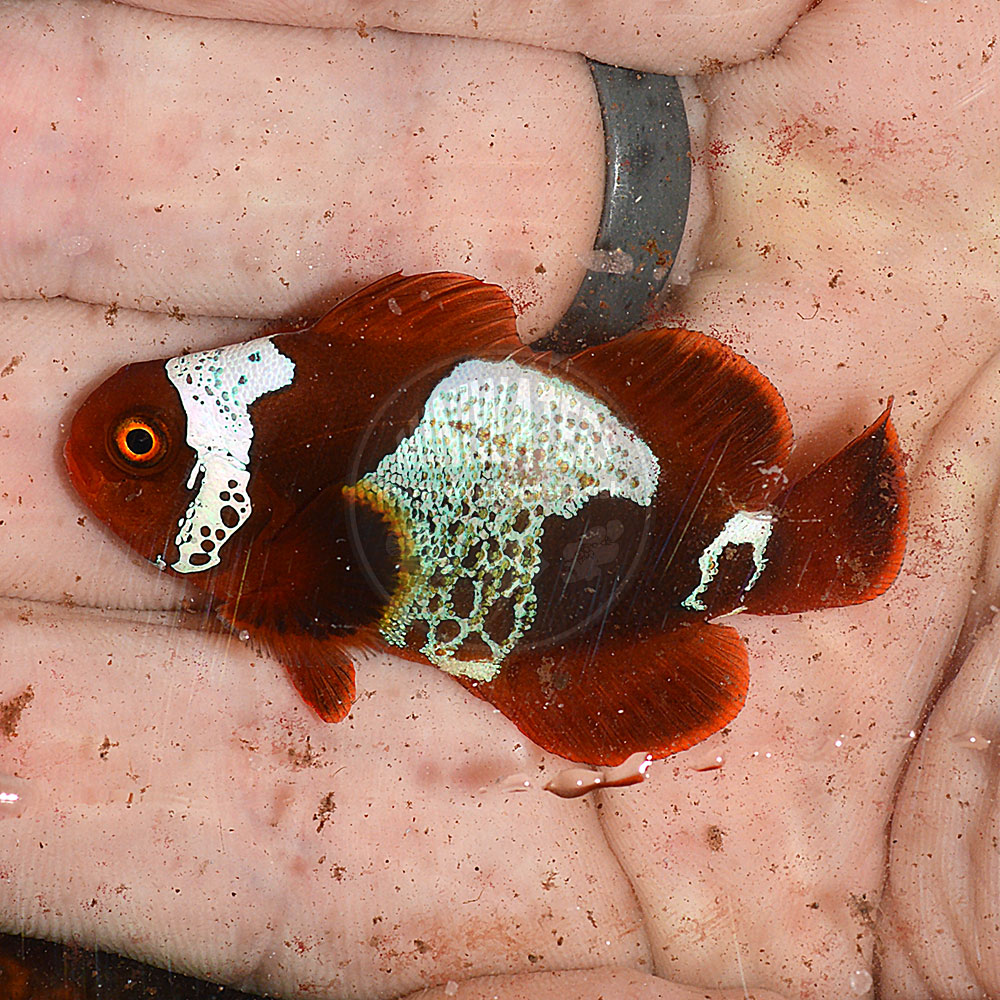
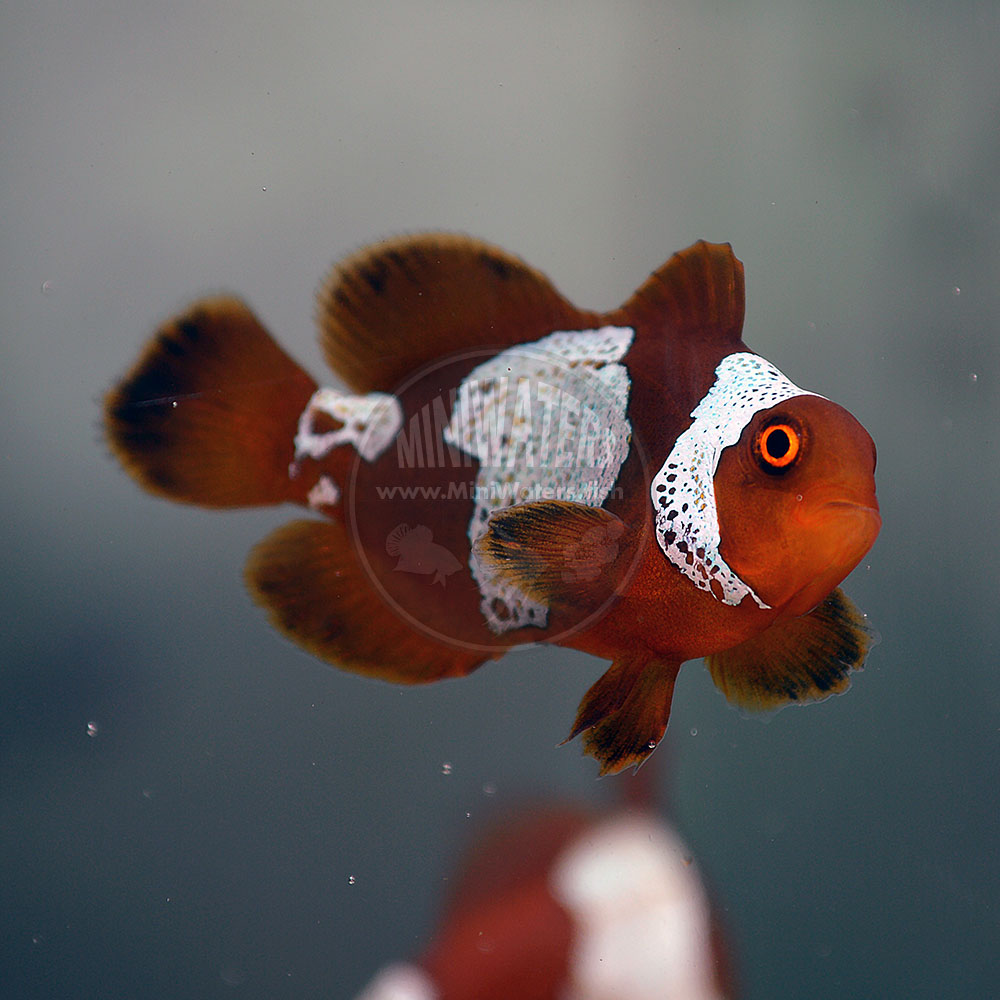
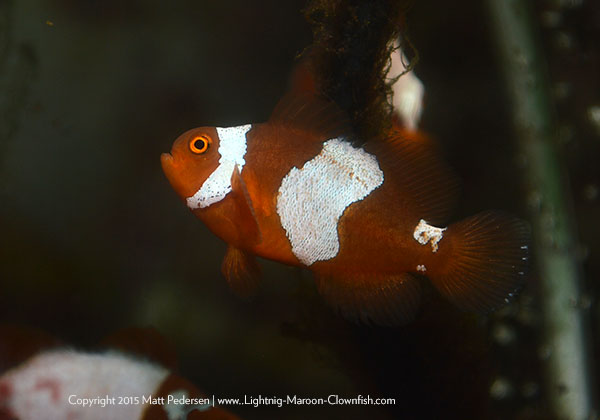
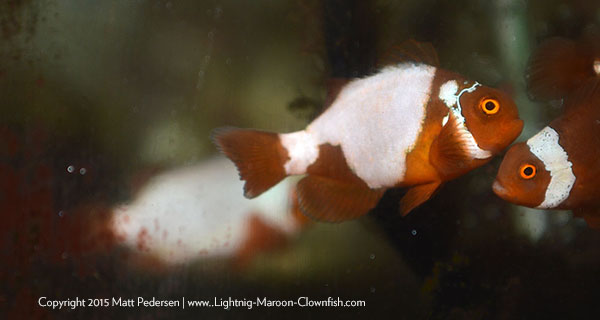
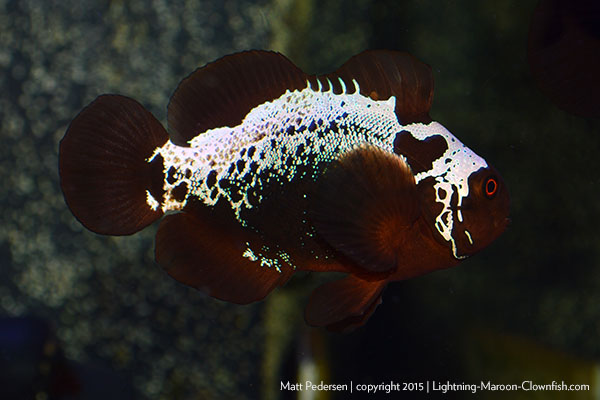
A WSYIWYG F1 PNG Lightning Maroon Clownfish, 2 years old, from the original wild pair! Available on MiniWaters.FISH
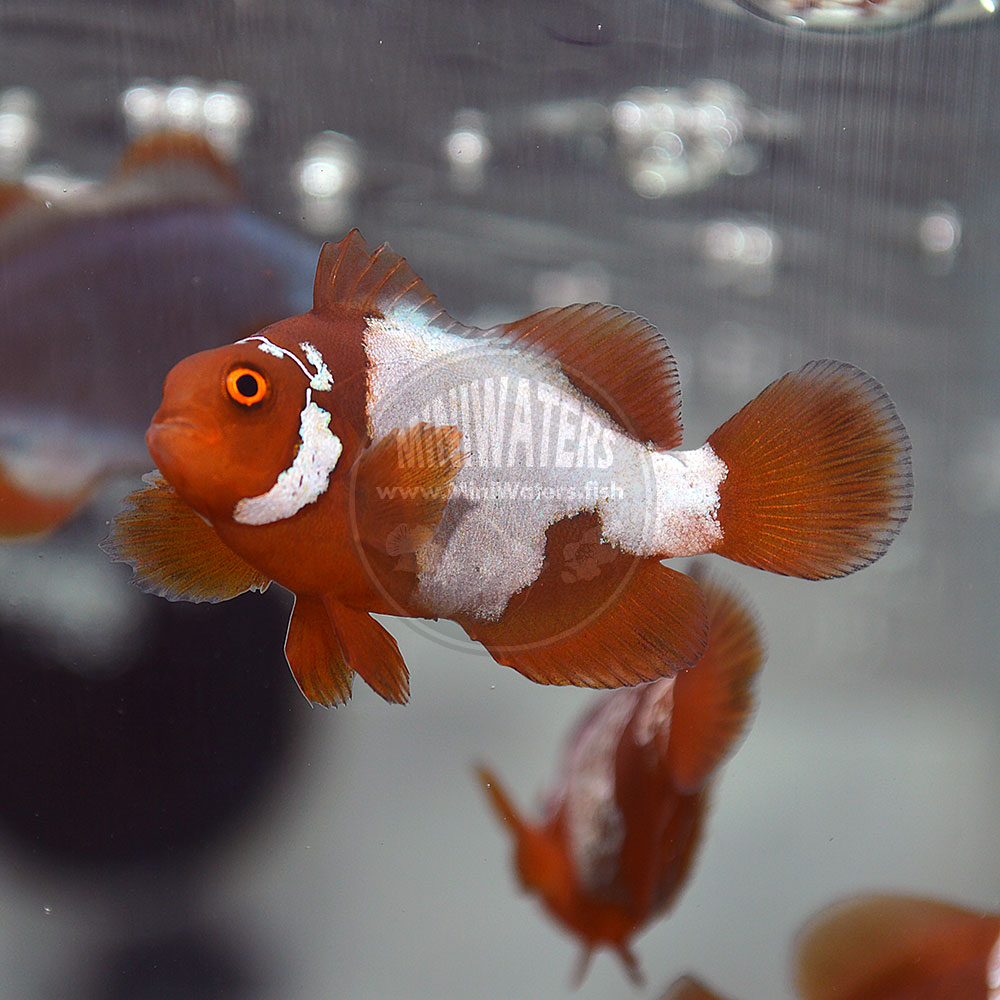
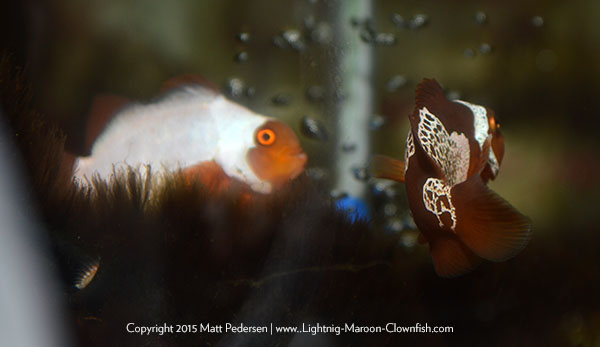
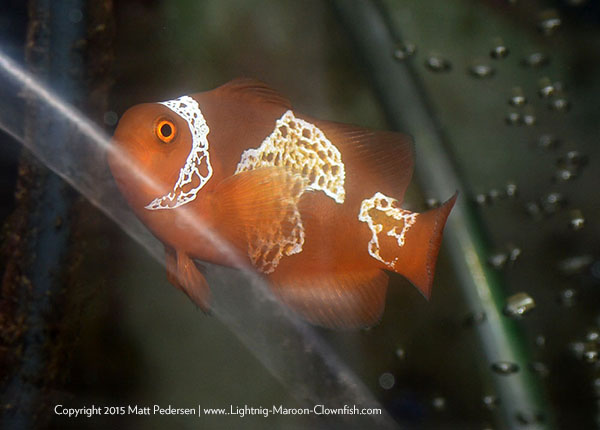
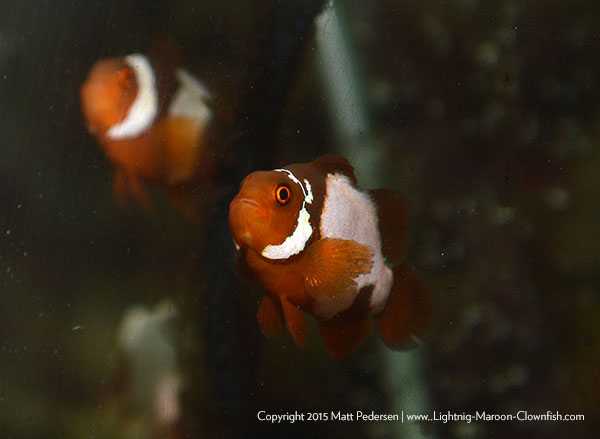
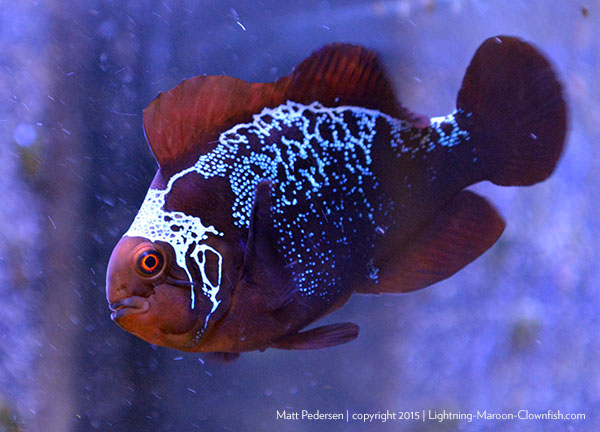
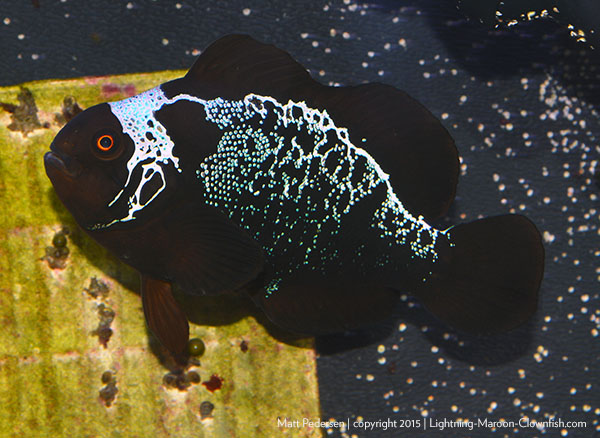
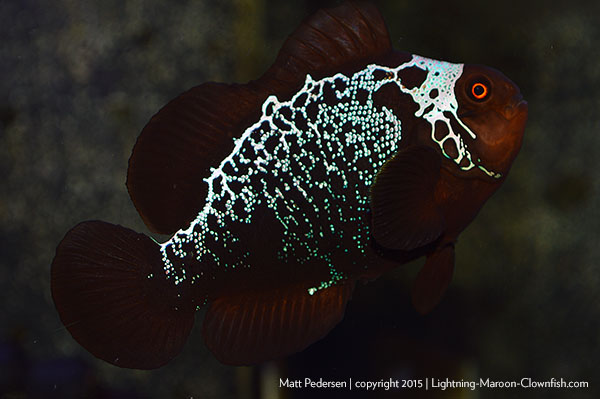
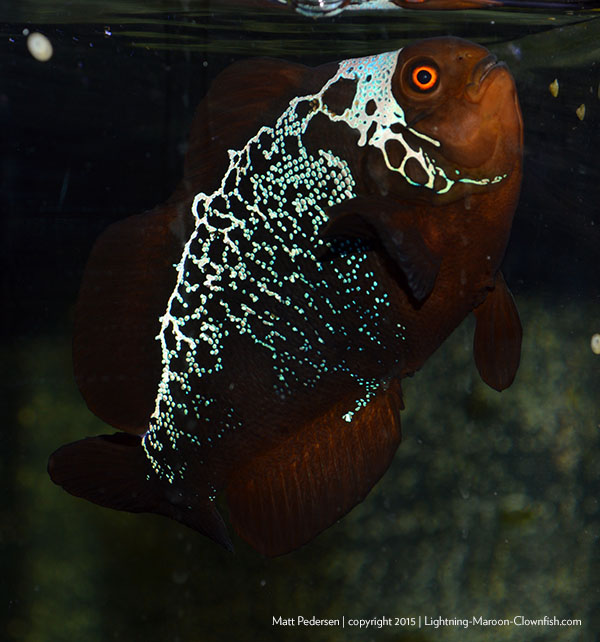
To be frank, we’ve been offering these fish at wholesale to stores, but have had very limited interest, which is surprising since so many of the shops had been asking for them for so many years. Furthermore, our breeding here in Duluth, MN, is currently the only production of high-coverage to all-white Lightning Maroon Offspring that I’m aware of, which means the shops and retailers that have wholesale accounts with us have access to very exclusive premium quality Lightning Maroons to ultra quality Lightning Maroon Clownfish that no one else can get! These are the fish like the pair I held back; the entire bodies of these fish are expected to break up over time into the lace-like network of red spots. And of course, we have plenty of more traditional type standard grade Lightning Maroon Clown offspring as well, and they’re not 100% related to the Sea & Reef bloodlines either.
You can find premium grade Lightning Maroon Clownfish like this for sale at MiniWaters.FISH
When it comes right down to it, as breeders, we need to sell fish. And as much as I run and offered wholesale exclusively for the past few years to “support the LFS”, if the stores aren’t buying what we’re producing, yet we know you guys WANT them, we had to find another way.
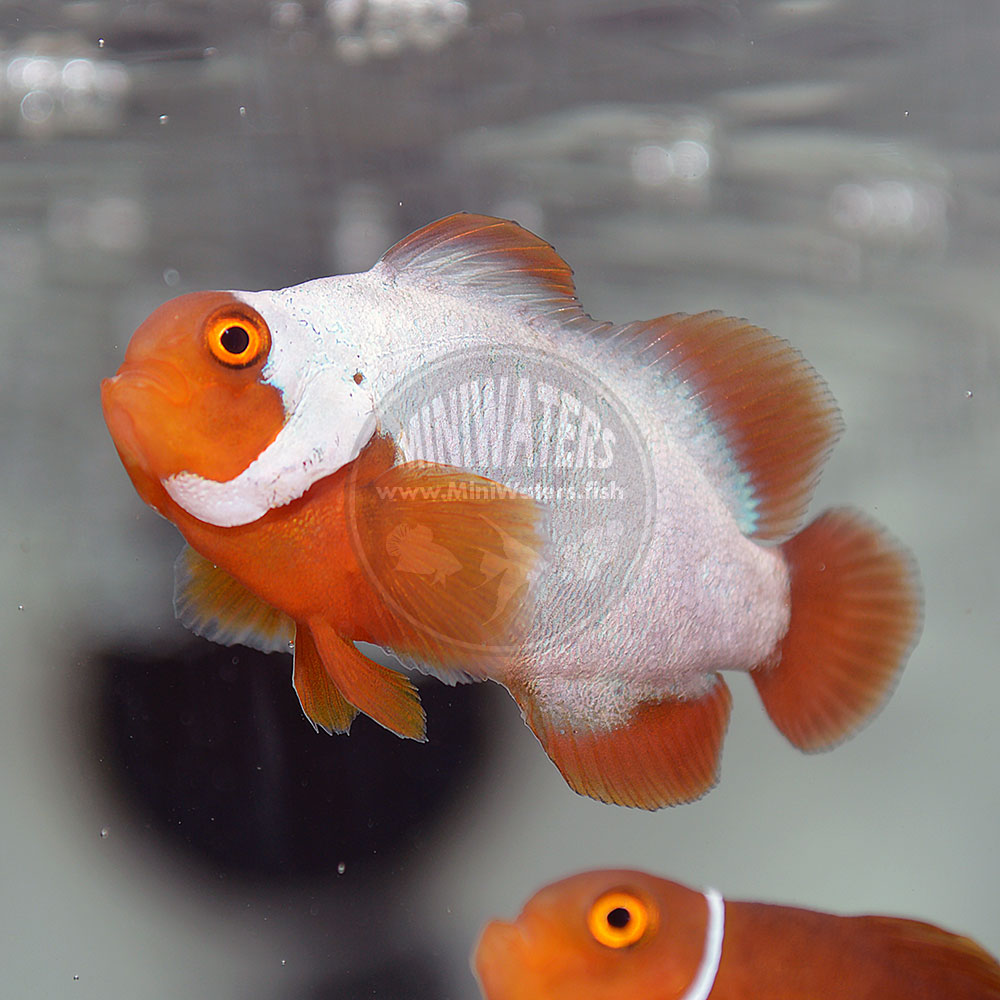
Yes, a solid white juvenile like this is going to be covered in pattern in a couple years – Lightning Maroons like this for now only come from Duluth MN! Buy them at MiniWaters.FISH
So as of January 1st, 2016, I personally launched MiniWaters.FISH. This is exclusive, direct from Matt Pedersen offerings of mostly captive-bred marine / saltwater fish (with the occasional freshwater offerings just to mix things up). Some fish are produced here, some produced by other breeders, and all carefully chosen to suit my own tastes first. In short, I’m only going to intentionally stock fish that IF they never sell, I’ll be happy to call them pets for their rest of their lives! If you like my tastes, then you’ll like what I’m offering. If you want to buy Lightning Maroon Clownfish, well, for obvious reasons, this is the first place I’d suggest you look!
And I’m still offering wholesale to local shops; my retail pricing is such that any shop should be able to purchase from my wholesale list and, if they desire, undercut my online pricing while still making an industry-standard basic retail markup on livestock. See the MiniWaters.FISH wholesale page for more information – I’m STILL trying to “support the LFS”!
Customers in the upper midwest have an added bonus; residents of MN, WI, Northern IL and Northern IA can get overnight shipping for as little as $10! Yes, MN retail customers, you get stuck with full Duluth city-rate sales tax..it is what it is…but shipping in the upper midwest is a screamin’ deal!
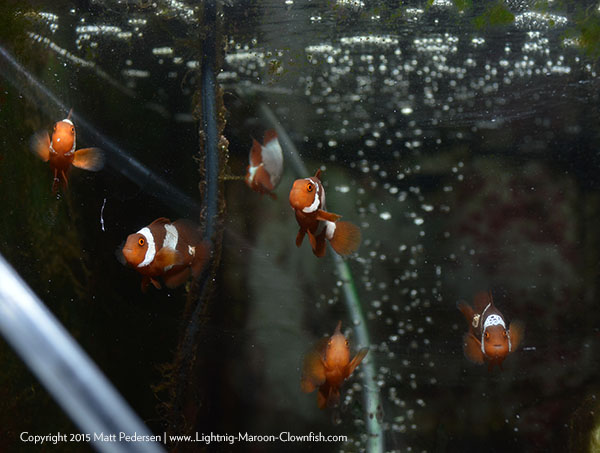
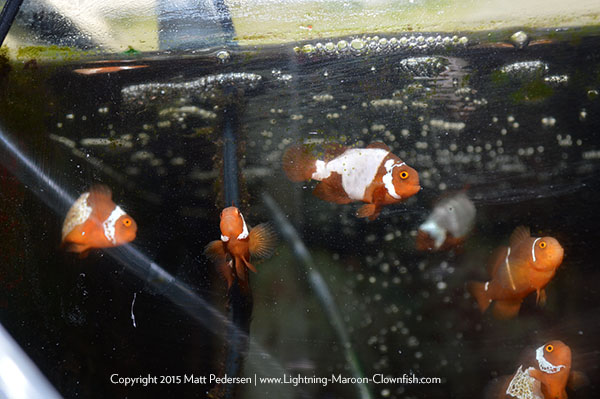
Standard Grade PNG Lightning Maroon Clownfish – shop for them at MiniWaters.FISH
So please be sure to check out MiniWaters.FISH. Please “like” the MiniWaters.FISH Facebook page too so you get updates.
I won’t be posting much in the way of “promoting sales” here on The Lightning Project per-say, as that’s not really the point of this website. But, breeders need to sell their fish and aquarists need to buy them, so…wholesale or retail, drop me a line at MiniWaters.FISH and maybe I can send something your way!
Back on November 23rd, I made a change in diet for most of my fishes to try out the insanely popular LRS feeds; specifically the new Fertility Frenzy. I purchased four 8 oz. flats for use in my fishroom, and 4 more flats went to Mike Doty’s fishroom to try on some problem spawners. As of today, I’ve gone through two of them; I’m using about 8 oz of this food per week.
While hardly a scientific and controlled test, I figured changing one variable in the routine (feeding a different food, and more frequently) would at least provide some insight. And if pairs which were not spawning suddenly sprung into action, well, wouldn’t that just be great? There’s been a lot of positive feedback but also some rather remarkable claims made about these feeds…on the one hand almost too hard to believe, but also too hard to ignore.
I instantly saw some fish willing to gorge themselves on feed in a way that perhaps they wouldn’t on others. The small particle size and gel binder is very reminiscent of Repashy’s Spawn and Grow formulation…so much so the cynic in me mused “is LRS just repackaged and augmented Spawn and Grow?” I’ve offered this food to just about every fish in the room…freshwater, saltwater, juveniles to adults. Most take it and “enjoy” it….my Altums (Pterophyllum altum) have a hard time with it, but the Betta smaragdina “Guitar” juveniles pounce on this food.
One of the Clownfish pairs that initially showed the most promise was the F1 Lightning X Lightning pair. Upon going onto the LRS Fertility Frenzy, I remember confiding in a fellow breeder that I thought the fish looked uncomfortably fat, and I was actually worried that this could lead to a problem such as egg binding. Well…my concerns were unfounded, the pair put down their most recent nest on Sunday, November 29th. This is their 25th spawn.
This first nest was no larger, or no better quality, than any of the prior nests. Perhaps only 6 days on the food is not enough to see the impacts of the new diet that most hobbyist feedback would lead me to expect.
Another possibility here is that whatever is driving nest size and quality might not be dietary in this pair. A third possibility might be that the prior staple diet, Spectrum’s Thera A, represents a comparable source of nutrition and thus, the switch to LRS could simply effectively be a lateral move (everyone knows Spectrum is a very solid, premium pellet).
It’s going to take several more weeks of feeding to make any sort of anecdotal observations that I’d put weight behind. But it does remind me that in breeding there probably isn’t a shortcut or magic bullet. Feed, while important, is only part of the equation.
Another post I’ll probably be updating for a while..just tracking spawns.
The most recent spawn of the Lightning X Lighting F1 pair here was on November 16th, 2015, their 24th spawn.
The original wild Lighting X White Stripe pair spawned again, a very small clutch of orange eggs, on Sunday, November 22nd, 2015; their 65th spawn. That comes out to 2 months since their prior spawn. What I had noticed happened is the LEDs on their tank have dimmed…I wonder if this has tricked them out of a spawning cycle. Plus, we are entering winter weather, although the environment of the fishroom should be largely unaffected in that regard.
It is worth noting that lately the fish have been almost exclusively on a diet of Spectrum Thera A, and nothing else. This is pretty much due to time and other priorities. Overall, nest sizes seem smaller when exclusively on this diet, and the egg quality simply doesn’t appear as solid. Just an informal observation at this time.
First up, housekeeping. I’ve been lax on recording spawn dates because these days, since I’m not actively rearing fishes until the fishroom rework is done, the info just doesn’t REALLY matter all that much. Still, might as well record them.
For the original wild Lightning X White Stripe pair, their most recent spawn was Sunday, September 20th (#64). That was proceeded by Monday, September 7th (#63). They had earlier spawns on August 1st (#61), and August 26th (#62) if my memory and documentation serves correctly.
For the F1 Lightning X Lightning pair, their most recent spawn was now Friday, October 30th, 2015 (#23). Before was Monday, 10/19/2015 (#22); prior was Thursday, 9/24/2015 (#21). Before that, 9/15/2015 (#20). Prior was Sunday, Sept. 6th (#19). Earlier spawns were August 1st (#17), and August 21st (#18).
Finally, Mike’s holdback pair is producing; parents are MD1 and MD2. Mike HAS been rearing, so we have a lot of F2 Lightnings and White Stripes which for the moment are becoming available through my livestock wholesaler. Ask for more info (retailers, wholesalers only please).
Before I simply forget, I need to note that the wild Lightning X White Stripe pair, the foundation pair, threw down a spawn I found on Sunday, 7-12-2015. This is their 60th documented spawn in captivity!
And now, 2 days later, the F1 Lightning offspring were putting down a spawn around 5:30 PM, 7-14-2015. This is the 16th spawn for the pair.
NOTE – this is basically a “first draft”, but I am putting it live at this time to facilitate and encourage discussion. I may revise / update/ correct as needed.
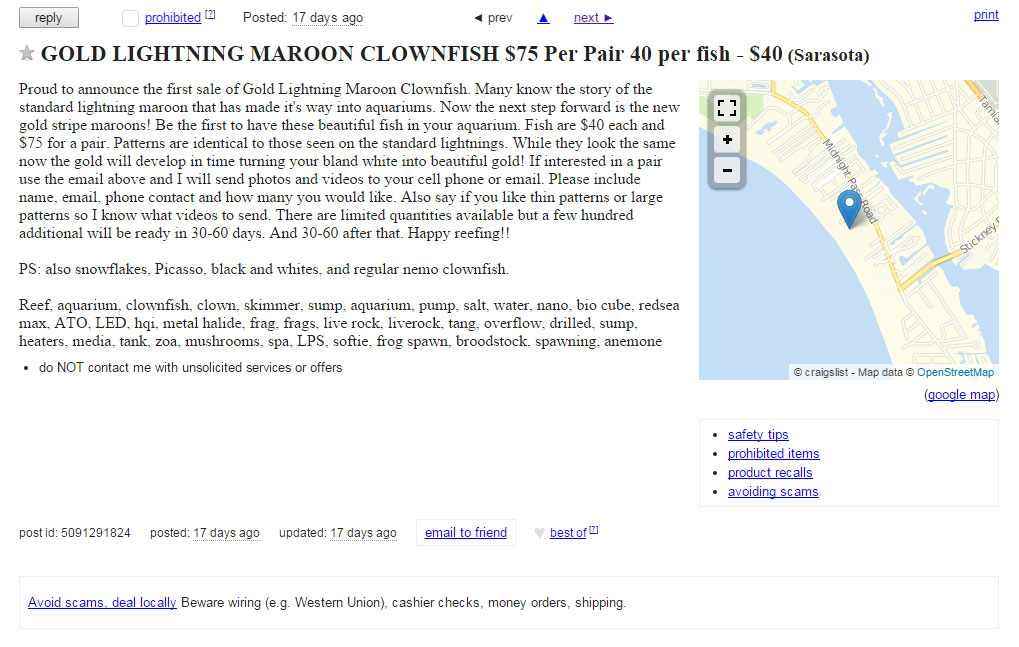
I’ve largely refrained from talking about the concept of creating a “Gold Lightning Maroon Clownfish” here other than to include mention of it in my “breeding directive” and my “public shaming list”. It is official…the Maroon Clownfish market is going to now be a BUYER BEWARE MARKET, and there’s no turning back. I have to be explicit and up front – NO ONE should be buying these fish or supporting the breeders who are producing them. I’ll get to the reasons why in a minute, but first, the details of the sketchy offer: The following “offer” of “Gold Lightning Maroon Clownfish” was made recently on the Sarasota Craigslist (I thought listing of animals for sale was against the rules in the first place?). http://sarasota.craigslist.org/for/5091291824.html – here’s a screenshot of the ad:
The text of the ad is as follows:
Proud to announce the first sale of Gold Lightning Maroon Clownfish. Many know the story of the standard lightning maroon that has made it’s way into aquariums. Now the next step forward is the new gold stripe maroons! Be the first to have these beautiful fish in your aquarium. Fish are $40 each and $75 for a pair. Patterns are identical to those seen on the standard lightnings. While they look the same now the gold will develop in time turning your bland white into beautiful gold! If interested in a pair use the email above and I will send photos and videos to your cell phone or email. Please include name, email, phone contact and how many you would like. Also say if you like thin patterns or large patterns so I know what videos to send. There are limited quantities available but a few hundred additional will be ready in 30-60 days. And 30-60 after that. Happy reefing!!
PS: also snowflakes, Picasso, black and whites, and regular nemo clownfish.
Reef, aquarium, clownfish, clown, skimmer, sump, aquarium, pump, salt, water, nano, bio cube, redsea max, ATO, LED, hqi, metal halide, frag, frags, live rock, liverock, tang, overflow, drilled, sump, heaters, media, tank, zoa, mushrooms, spa, LPS, softie, frog spawn, broodstock, spawning, anemone
Now, up front, I do not know who the breeder is who is offering these fish. There are two people I know who are actively pursing this project. This ad makes all sorts of promises that, at this point in time, are unlikely to be possible. I’ll return to those later. Just know, up front, I find this offer suspect on many levels. It may well even be a fake, an internet “troll”. Real or fake, it provides a springboard for discussion, and that is part of what the Lightning Project has always been about. First, the facts.
To really dig into this topic, it’s going to require a lot of back story to get you up to speed. It may make you read additional articles as well. But to truly treat the topic properly, I can’t just say “this is bad, don’t do it”. I have to show you how, and why, all the way from the beginning.
White Stripe Maroons are well known as Premnas biaculeatus, and are found in the Pacific Ocean. Gold Stripes however, come from the Indian Ocean. There are numerous differences between the Gold Stripe and White Stripe variants, so much so that at one point in the past they were described as separate species, the Gold Stripe being Premnas epigrammata. I’ve written extensively on this topic for CORAL Magazine / Reef2Rainforest.com, so if you want to delve into the details, please do so here; “Clownfish Species Hiding in Plain Sight?” and “Geographic Variants Within Clownfishes: Maroons, Ocellaris and Perculas“.
To summarize my view of the state of Premnas, I believe there are actually 3 distinct biogeographic groups; two forms of “White Stripe”, P. biaculeatus which can roughly be grouped as the easternmost cluster (Solomon Islands, PNG, Australia’s GBR) and the Indo-Philippine group (Philippines and the Pacific waters of Indonesia, excluding “West Papua” which is part of the New Guinea landmass which includes PNG). The remaining group is the Gold Stripe species, which I tend to refer to as P. sp. epigrammata or even shorthandly as P. epigrammata. I should note that the species name epigrammata is actively used in other parts of the world for the GSM; in no way am I alone in my assertion that we should treat the Gold Stripe Maroon as a distinct species.
Under the current rules of taxonomy, P. epigrammata is not considered valid, and per the rules of taxonomy, “Gold Stripes” are considered the same “species” as “White Stripes”…for now. That said, taxonomy is fluid, and while I’ve said it is “inherently flawed”, others would prefer I think of it as simply “always self-improving”. Granted…not every change is an “improvement” in my opinion. To illustrate the problems inherent when we rely solely on taxonomic standing to determine what is, or is not a species, I can point to myriad examples. Consider the story of Amphiprion barberi, a species which has carried THREE different names within my own lifetime. The short of it, if we had relied solely on taxonomic rank to determine which fish were suitable mates to “prevent” hybridization, then we could have a slew of hybrids on our hands, but they were “acceptable” under the guise of taxonomy (read more at “It was always the Red Clownfish from Fiji; Amphiprion barberi“). Biogeography Is What Really Matters
The reality of ALL ornamental fish conservation and breeding is that biogeography is the only reliable measure by which we can maintain pure species lines within captivity. This is practically the NORM nowadays in the freshwater world; I just finished editing a series of articles for AMAZONAS covering wild Betta species, many of which are of elevated conservation concern. Since the taxonomy of these fishes is not well understood, breeders are being directed to know exactly where their fish come from, because what is Betta unimaculata today might be Betta ocellata tomorrow. But where it was harvested from doesn’t change. The most extreme example would be that even though there appears to be no difference between the PNG White Stripe Maroon and the Solomon Islands White Stripe Maroon Clownfish, we ought not breed them together because we might one day find out they’re “different” and as such, from a genetic conservation standpoint, shouldn’t be mingled. This may sound extreme, until you consider that the Banggai Cardinalfish, Pterapogon kauderni, apparently has something in the range of 14 unique genetic clades within its on very small natural range, and some conservation biologists have put forth that in order to really preserve the species, each one of those clades should be maintained independently. To dramatize the issue, this could very well mean not mixing fishes from two neighboring islands within the Banggai group! Even I think that, pragmatically, maintaining 14+ individual genetic subgroups of what is clearly one species is unrealistic and probably overkill, but the scientists are not necessarily wrong in their thinking; in a perfect world, what they propose is what we’d do.
This may all seem inapplicable to clownfishes until you realize that there are potentially dozes of undescribed species currently lumped into a single unit. Clark’s Clownfish, Amphiprion clarkii, covers a slew of variants spread out over both the Indian and Pacific Oceans. When you look closer, there are two VERY obvious and distinct groups; at minimum, these two probably should be reevaluated and split into two distinct species. However, digging deeper, there’s at least a third almost indisputable outlier that I think would be considered another species, and depending on how much you want to split, there could be 11 different species (read more: “Geographic Variants Within Clownfishes: Clarkii Complex“). The same exists within Amphiprion chrysopterus, the Blue Striped Clownfish. At minimum, there are two species, but more likely, 3 to 5 (see “The Challenging and Diverse Blue Stripe Clownfishes“). Ultimately, taxonomy will be redrawn into new, hopefully better lines, but regardless of the name or names these populations are all lumped under or assigned to, every single one of these types is biogeographically linked (found in only certain places, replaced by something different in other places), and each one is visually unique. The Breeder’s Conservation Obligation
Conservation-minded individuals will likely need no persuasion regarding the value of this naturally-occurring biodiversity. Yet it seems that aquarists, the ones who ought to treasure it the most, could often times care less. This is unfortunate, because in a world where clownfish breeders are often trying to outdo each other with their latest “twist” on a name for a Picasso Percula Clownfish (citing things like a particular muttonchop or helmet pattern to be something unique to their breed and more than it actually really is), we have real fishes with real unique traits already created by mother nature.
If find it incredibly disheartening that breeders are not extolling the virtues of these natural fish and latching onto this treasure trove of diversity, but I also must lay blame on the motivating factors – people are all to easily duped into paying for hype, and designer clownfishes are bar none the most easily hyped. Hell, since Sea & Reef started producing Lightning Maroon Clownfish, I cannot tell you how many times people have said “mine are better” and that “mine are worth more”. I’ve never said any such thing (and in fact largely think exactly the opposite); in truth people see a visual difference in my fish and presume there is something different about them. The reality is that whatever is different between my offspring and Sea & Reef’s could be genetics, could be nothing more than rearing environment or foods offered. Until there is some actual PROOF, I think it’s terribly foolish, and yet the hype is there, created by the masses themselves. The worst part is that Sea & Reef’s offspring are all direct descendants of one of my own F1 offspring; why would anyone think mine are better than his, considering that the offspring MINE produced are HIS offspring?! See the logic, and thus, the flaw in the thinking that is driving the hype?
But I’m off on a tangent, so let’s get back on track. At the end of the day, marine fish breeders like to think that they’re playing some active role in conservation or being good stewards of the reef. I’ve written about the Aquarium Ark concept at length on more than one occasion (most recently, see “The Role of Captive Propagation in Clownfish Preservation” and “Changing Our Clownfish Mindset“). For all its detractors, I can only say this – it’s happening. You cannot prove otherwise…because it’s already happened and it will continue to happen; I only needed to prove it happened once for the concept to be valid, and yet, I have dozens of examples.
As recently as tonight I read the commentary from someone who implied that the only way aquarists can impact conservation is that a captive bred clownfish keeps one of the reefs. In fact, that point is at times debated, the counter argument a suggestion that either captive bred fish also drive up more demand for wild counterparts, or that captive bred fish are not reducing wild caught volume, but instead are only reducing the growth in harvest pressure. I don’t have data, so none of this is fact; it’s simply a rhetorical hypothesis.
But what I do know is fact is that we have many real world examples of species which are being saved, produced by the commercial aquarium industry, solely because we like them and want to put them in our tanks (case in point, read “Nearly-Extinct Redtailed Shark Isn’t Gone Yet“). While governments sit and wonder why the fish are disappearing, or even outright cause their disappearance, it is aquarists, and yes, at the hobbyist level even, that are solely responsible for keeping them around. I’m thinking everything from Red Tailed Sharks and Goodeids, to the well-reasoned fears surrounding the future of dozens to hundreds of endemic Rio Xingu species once the Belo Monte dam project in Brazil is completed (there is a lot of AMAZONAS Magazine coverage on this issue – here’s several articles to read up on). I’m sorry, but if governments were going to save Hypancistrus zebra, the Imperial Zebra Pleco, they wouldn’t be destroying its habitat so they can generate electricity. The real world history, the reality, is that the responsibility of stewardship DOES ultimately rest on every aquarist.
As such, we already have real world examples of problems with marine fishes, specifically clownfishes. I’m thinking of the Darwin Ocellaris. Here again, I believe it is a distinct species based on behavioral and reproductive differences as well as biogeographic isolation. Again, without going into many details, the reality is these days that a) we cannot get wild caught Black Ocellaris (anyone who says otherwise both hasn’t tried nor has talked to the collectors in Darwin proper), and b) based on my assertion that Darwin is a unique species, we may have already lost it to hybridization in the aquarium trade. How? Black Snowflakes – Harbinger of What’s To Come for Gold Stripe Maroons
Well, everyone wanted “Black Snowflakes”. First, dispense with any notions that species cannot hybridize and create viable, fertile offspring. That notion is ancient and also disproven by the 150,000 or so registered Orchid hybrids which don’t simply cross species lines, but many of which cross multiple genera (plural of genus in case you didn’t know) and could consist of dozens of species.
At the end of the day, whether you think Darwin Ocellaris is a unique species or not, the reality is that when mated to an typical Orange A. ocellaris, the results mimic what you expect from a primary hybridization event; juveniles of consistent intermediary appearance (there are multiple types of hybrids, the appropriate jargon for aquarists is included in my CORAL Magazine article on Hybrid Clownfish).
The reason this happens is simple…they get half the genes from the Darwin Black parent, and the other half from the Orange Ocellaris parent. If “Black” Ocellaris in Darwin were simply a genetic mutation that outcompeted the standard form, then you would more likely expect to seem some pure orange, some pure black…maybe a few subgroups within the result. But what you get in the first hybridization is the MOCHA clownfish. We all know it, and the results are easily replicated at this time.
So, to create Black Snowflakes, all it took was the mating of a Snowflake Ocellaris to a Darwin Black to start off the project. Snowflake is a dominant gene, and at this point the working hypothesis is that it is a single locus gene, and that the double-dose (homozygous for Snowflake) is fatal. Preliminary numbers suggest that. It just so happens this might also be how the Lightning gene in PNG White Stripe Maroons works. At any rate, just like our Lightning Maroons, in the first generation of the “Black Snowflake” project, the results are 50% Mochas (3 stripe, wild type offspring) and 50% Snowflake-carrying Mochas, which was first named S’more by Jonathan Foster of Fisheye Aquaculture, but we’ve generally come to know them as “Black Ice”. Anyone familar enough with Black Ice Clownfish knows they are no “Black Snowflake”
So the project continues. The fastest way to keep moving is to take one of the “Black Ice” offspring and use it as a male with an actively spawning Darwin Black female. In probably less than a year, you could have offspring which are now 75% Darwin Black, 25% Orange Ocellaris. Because of the Snowflake gene’s behavior, 50% will be wild-type, 3 striped fish, and from their young Black Ice father, the other 50% once again get the Snowflake gene. The fish are all generally darker, but here again, not outright pure black fish generally. Some producers doing these projects simply passed off these offspring as Mochas and Black Ices…and if a fish was dark enough, they might have sold it as a “Black Snowflake”. But, judging by the way a couple commercial producers have followed suit, the reality is that this new hybrid back cross was given the name “Chocolate Mocha” for the wild types, and “Blacker Ice” for those which carried the Snowflake gene. As such, if you buy a “Blacker Ice”, that name SHOULD tell you something about the genetic makeup of the fish, including how it differs from a “Black Ice”.
The actual road to a Black Snowflake probably took yet another back cross, taking a “Blacker Ice” and mating it back to a Darwin Black Ocellaris again. So, a further reduction of the “Orange Ocellaris blood”, the offspring being now 87.5% Darwin Black, and only 12.5% Orange Ocellaris. This is all but proven at this time, as commercial producers haven’t said explicitly “this is how we did it”, but, it’s easy enough to figure out when no one has yet bothered to name a “Even Blacker Ice that’s not yet all black”. Logically, it’s easy enough to see how by this point, in two admittedly closely related fish, you’d have a solid percentage (if not all) off the offspring maturing fully black. And this is where the big problems start.
For a Black Snowflake, it’s easy enough to recognize it as the hybrid that it is but ONLY if you a) know the history of how it was created and b) understand why, regardless of taxonomic standing, it’s a hybrid that wouldn’t be suitable from a conservation standpoint. These are issues of “fact”, and those who opine otherwise do so ignoring the facts, which is why I cannot take what they say very seriously. But there are still issues. Some of these fish may still not be “fully black”, which might leave some producers to sell them as “Black Ice” or “Blacker Ice” based on appearance, and not genetic makeup. By the same token, not all “Black Snowflakes” might be the same…some producers may have still undertaken more back-crosses to “firm up” the Blackness of their offspring…eg a third backcross would result in fishes that are now only 6.25% Orange Ocellaris, and 93.75% Darwin Black. A fourth backcross? 3.125% Orange Ocellaris, 96.875% Darwin Black. The only reason I keep drawing out the math is to hit home one of the must fundamental facts that one has to realize – once a hybrid, ALWAYS a hybrid. You can never “breed out” every last gene that came over from the Orange Ocellaris. Now, in some settings, biologists have conceded “defeat” and said that a “hybrid species” is “good enough” for species restoration work. In my opinion, that’s both giving up but also we stand at the point where we have knowledge of past mistakes and shortcomings…we do NOT have to repeat them. So why should we?
And this is the real problem – for all the “Black Snowflake” production going on, there is a large group of outwardly solid black “Black Ocellaris” that are a by product of production. All of these fish need to find homes too. So what are THEY sold as???
Well, officially on the record, at least one commercial producer was selling them out as Black Ocellaris with no mention of their hybrid nature. And with that one simple admission…the genetic integrity of every “Darwin” or “Black” Ocellaris becomes questionable. Once the hybrids are passed off, even if unintentionally, as pure fish, they make it into someone else’s breeding programs as a pure fish. Once you pollute the population, you cannot take it back. And since you cannot tell by looking, mistakes are going to happen….and they could happen even with the most savvy of breeders.
These days, to knowingly find a pure Black Ocellaris is *almost* impossible, simply because a) we can’t get wild ones at this time and b) it’s been a few years now since Black Snowflakes came around, and their siblings have all been pumped into the trade. Only people with very old pairs that pre-date MOCHA breeding can be 100% sure that theirs are either wild or pure descendants of wild fish. Each year that passes under the current status quo, the difficulty in finding pure fish will only rise further. A Tale of the Intrinsic Good, now Lost
Now, again, argue all you want, but at the end of the day, the aquarium hobby and industry has already served as the “conservation vessel of last hope” for fish species. Should something happen to the Darwin Ocellaris, 10 years ago it would have been reasonable to assume that you could find pure examples of the species in captivity. But now, as a result of our pursuit for the “Black Snowflake”, we have sacrificed the ‘easy conservation win’ for the Darwin Ocellaris in the trade. No longer can you just see a Black Ocellaris and presume it to be pure. Instead, a massive amount of back tracking will have to happen. Savvy breeders won’t be overly concerned, but the reality is that long before you become a savvy breeder, you are a newbie buying fish without care or understanding of things such as biogeography, species provenance or purity. You simply pick the fish you like, the fish that are readily available and cheap, and you start breeding. In short, if Black Ocellaris is “your desired fish”..you’re more than likely going to perpetuate poor or impure lines than ever knowing otherwise. Unless there is a massive change in the attitudes of all marine fish breeders to own up to our conservation responsibility, and to attempt to educate breeders from the day they start ON that responsibility, we will lose the pure Darwin Ocellaris. It might not happen overnight, and more likely it would take decades. But in many respects, we’ve already lost it and it’s a difficult road ahead to change our mistake. Do we let History Repeat Itself?
And hopefully how you’ll see the core reason why I’m so against the “Gold Lightning Maroon Clownfish” project from the get go. It is virtually a clone of what happened with the Black Snowflake and Darwin Black Ocellaris, where the hubris of a few breeders wound up screwing the species in the process.
Now, in their own defense, I’m not sure the breeders of the day were even thinking about this…after all taxonomy says Darwin Blacks are the same species, A. ocellaris, and there was so little info about the Darwin Ocellaris that no one really gave it much thought in the first place. It wasn’t until I talked directly with collectors in Darwin that it was confirmed that there are ONLY Black Ocellaris in Darwin and the region…no orange ocellaris exist there.
So you can imagine my frustration, dismay, and outright infuriation with the breeders who, having been told 10 different ways that pursuing the hybridization of Lightnings with Gold Stripe Maorons was wrong, and shouldn’t be done, have done it anyway. Particularly since I, and others, spent a lot of time, effort and money to do everything we could to ensure that not only was the Lightning Maroon Clownfish line pure, but that we could actually have a pure PNG provenance population right alongside having a beautiful designer gene to play with.
Up until this year, there was very little worry about Maroon Clownfish hybrids. All of the Gold Stripe, Gold Nugget variants were developed in pure Gold Stripe Maroon populations, and the Lightning and Morse Code genetic were restricted to the PNG White Stripe group. We had two pure populations doing everything they could to both give consumers the designer fishes they want, while also fulfilling our conservation duty. So this is how it’s going to go down – Why “Gold Lightnings” probably cannot be…yet
First…to the notion that there are any “Gold Lightnings” to be had, here’s what I think.
For starters, you have to look at what the hybridization of GSM with WSM does. There’s been rumors for a long time (10 years or more) that if you hybridize GSMs with WSMs you do not get more GSMs and WSMs….that seems obvious given my stance that they’re different species, but just like Black Ocellaris, it’s important to know because of in fact, you did get say, 50% GSM and 50% WSM, it would imply that “Gold Stripe” was possibly nothing more than a single mutant gene, and NOT a collection of biogeographically isolated genetics that would support specieshood for the GSM.
Finding the proof of these past hybrids however, escaped me. This year, however, a young and very brash breeder, Thomas Herrick, who operates under the guise of “Herrick Bros. Aquaculture”, took exception to my prior statements when he showed off a GSM X WSM hybrid offspring that showed hints of gold in the bands. To put it bluntly, he seemed to think he had disproven what I said a year prior on the topic, but in reality all he had done was provide the evindence that proves the intermediate form…a blending of the two parental species, resulting in traits from both being present and/or competing with each other (although in some cases, certain species traits drown out the traits of other species). The fact of the matter is, there remains no evidence that in the primary hybrid, the first generation offspring between a GSM and WSM will show fully gold bars that are indistinguishable from, for example, a mature wild Gold Stripe Maroon. The hybrid has been simply dubbed the White Gold…it makes a lot of sense. All signs point to an intermediate form between the two parental forms (or again, as I think of them, species).
Given the evidence to date, we must also look at the timelines at play. The first releases of my F1 Lightning Maroons occurred 2 years ago. I know where all those fish went, and I think for just about every single one, the breeding partners were white stripe maroons. There were very few releases in the 2nd year, and again, those all went to WSM pairings. In short, it is HIGHLY UNLIKELY that any of the F1 Lightnings I released are being used in Gold Stripe Maroon hybridizing projects at this time. They certainly COULD be, but more likely not. Sea & Reef Aquaculture is currently the only commercial scale facility producing Lightnings and as such, represents a source that only came online about 9 months ago. It is THESE fish that started getting thrown into GSM hybridizing projects, and in reality, the projects I am aware of did not start until 2015.
Now, it takes about 6-12 months to get white stripe Maroons to what I would consider market size. We’re only 7 months in on 2015. Even if someone got one of the first releases from Sea & Reef, and IMMEDIATELY paired it successfully with an actively spawning Gold Stripe Maroon Clownfish, the oldest the offspring could be is only 8 months or so. But probably less. Which means that, odds are, if there are any fish at all being offered as “Gold Lightnings”, they are probably less than 8 months old. Simply put, they can only be the first generation progeny of an initial hybrid pairing. Why? To date, the youngest sexualy mature MALE clownfish I’ve ever heard of is 8 months of age. So, by the timelines alone, at the absolute best, only RIGHT NOW could anyone *maybe* be working on the 2nd generation back-cross to a Gold Stripe Maroon.
If the fish can only be first-generation offspring, then they are NOT going to be fully Gold from a visual standpoint..that’s what the results to date suggest. They may show SOME hints of yellow, but nothing like a true and pure Gold Stripe Maroon. There simply has not been enough time yet to do enough back crossing yet to further reduce the WSM gene load to the point where the fish will probably start behaving / looking like “pure” GSMs. Yes, I must acknowledge that it is POSSIBLE that one of my first Lightning Maroons was used for GSM hybrid purposes immediately 2 years ago, and yes, if that happened, we could be looking at second generation back cross fish. Everything I know to date simply says this isn’t what happened. No one spent $1000+ simply to now be selling fish for as little as $35 “retail” upon their “introduction”.
Furthermore, just from a technicality standpoint, it would be more appropriate to call these first generation hybrid offspring as White Gold Lightnings….in fact there never will be Lightning gene in a pure Gold Stripe Maroon, Premnas epigrammata, unless it is discovered / occurs spontaneously within pure GSM populations. It’s pretty safe to presume that going forward, ANY fish being passed of as ANYTHING “Gold” with a Lightning gene is a hybrids.
But…just like the Black Snowflake projects, there are going to be wild-type, 3 striped offspring. So whoever this breeder is, is also putting out “White Gold” Lightnings. Unlike MOCHAs, White Gold, from what we know, will be indistinguisable from any other type of 3-striped maroon for at least the first 8-12 months of life. But probably much longer…and because the only visual difference (again, unlike MOCHA) is going to be stripe coloration…we are literally going to be stuck debating hues of yellow in an effort to discern a “White Gold” hybrid from a pure WSM or GSM. Knowing that GSMs and WSMs already get mixed up by suppliers on occasion, this is REALLY going to screw things up. Before now, you either had a fish that stayed white, or it DID TURN. Now, you’ll have fish that “kinda maybe sorta could be a GSM?” So here’s what the seller is doing:
The seller appears to be selling on hype. Unless the seller started this breeding OVER A YEAR AGO (again, highly unlikely as I know where all my fish went), the seller cannot have any fish old enough to draw ANY conclusions about how yellow (if any) they will turn. So when the seller claims that “While they look the same now the gold will develop in time turning your bland white into beautiful gold!”, the reality is that all facts and observations to date suggest this will NOT happen.
And perhaps that selling price should tell you something too…$40 each? $70 for a pair? A good pure quality GSM sells for more. What are you actually getting for a $40 buy in?
And why, if this was truly the worldwide release, would you make it on Craigslist? Only in your local market no less.
Nevermind this other simple thing that people overlook – Gold Stripe Maroons are NOT GOLD at the edges of their stripes. White Stripe Maroons have narrow stripes, and the netting effect created by the Lightning gene narrows things down even further. When you narrow the stripes of other clownfishes, you don’t get what’s in the center, you get what’s at the edge.
So since no one has actually seen a ‘mature’ Gold Lightning (remember it can take 2+ years for the pattern of a Lightning Maroon to really start coming in), if I were to speculate, one of two things will happen in this line of breeding. Either the stripes get thickened with back crossing, which will change how the gene looks (admittedly could be cool) or the stripes will remain narrow, and in the end, you might never visually tell a mature hybridized Lightning from a pure one. In short…the stripes might still wind up white…or dirty white. How These Projects Ruin Captive Populations
With the known results of what these hybrid projects create, they stand to ruin both the purity of the GSM and WSM populations as they currently exist. All the wild type offspring, in my opinion, have an equal risk at making their way, unknowingly, into breeding projects for pure GSM or WSM.
For the F1 “White Gold Lightnings”…well, I think people will jump on them as cheap “Lightnings” and the fact that they carry some GSM genes will quickly get overlooked. And people WILL mistakenly buy them presuming that “all Lightnings are descendants of PNG” which makes them “PNG”. Even if the hybridized Lightnings do in fact look different upon maturity, that takes over a YEAR to reveal itself. Someone mistakenly buying a hybridized Lightning Maroon isn’t going to find out about that problem for at least 6-12 months…IF they ever do.
It’s getting worse too, because breeders are being very tempted by the mad-scientist / ego-driven / profit-driven realities of doing things like starting to throw Gold Nuggets or Gold Flake Maroons into pairings with Lightnings. Either way, the designer lines of GSM are already at risk from wild-type White-Gold hybrids making their way into breeding programs misidentified as simply “GSM”; throwing the designer GSMs against Lightnings now only accelerates the pollution of WSM genetics into these GSM subpopulations. So very quickly, you’ll also find yourself looking at “White Gold Nuggets” and “White Gold Flakes”…which are going to look like piss-poor versions that simply fail to color up like they should. Wow…REAL PROGRESS…right? Pissing on Your Fellow Breeder
I also find these projects entirely disrespectful. They are disrespectful to the people who they got their fish from, and they are disrespectful of any breeder who doesn’t see things their way. The reality is that a conservation minded ethic is sorely needed in marine fish breeding; so long as species conservation is given a first priority, everything else can happen too and we’re ALL better for it along the way. Of course, I cannot make every breeder see beyond their own tanks.
Again, other than a couple people, everyone involved with Lightning Maroon breeding worked really hard to keep Lightnings pure, and everyone buying them and their siblings has had the easy piece of mind that they were getting PURE PNG fish…whether they cared or not! That was the beauty. Even if someone could give to sh*ts about “conserving a species”, their purchase was in fact helping to do so (this is truly how the Aquarium Ark WORKS…regardless of what detractors “think”). Again, this is a WIN FOR EVERYONE. And all it takes to keep perpetuating that is to simply put that as the first priority. Just don’t screw with that, and everything else falls into place. Plenty of gravy for everyone.
Sadly, because of these hybridizers who went ahead with their GSM X Lightning Projects, now, new breeders won’t know. “Pure” fish will now be a subject of inquiry and locating, as sources can no longer be trusted by default. People will breed with, and pass along, things as fish which they aren’t, perpetuating the problem created by this hybridization. Breeders will grow and come to learn that their broodstock is garbage…and well…what happens then? It’s not like they’re going to put down those fish..so they either shrug and keep producing rubbish or they pass off rubbish producing fish to someone else…who in turn wants to recoup their own investment…so the breeding continues. TRY to find a WILD Darwin Ocellaris. For that matter, try to find one you can actually TRUST as being legitimately PURE. I know of only maybe 3 places I can turn to, and they’re all hole-in-the-wall private breeders (to be fair, I haven’t asked every commercial breeder about their “Black Ocellaris” offerings and broodstock yet…because I’m not actually looking for them at this time). There will be people who think I’m being overly dramatic, exaggerating, or plain out making this all up. I need only point to the Florida Fish Farms and their production of livebearers over the past 70 years. Virtually ALL the livebearers…mollies, swordtails, platies, are cocktails of multiple species. Meanwhile, some of the actual species themselves are under threat, endangered, or even going extinct in their native locales, and governments are not stepping in to stop this (at times they’re even the cause). So you wind up with this strange livebearer community where you have a relative handful of people kinda keeping some rare wild species and populations going in captivity, while you have millions of “junk” ornamental fish pumping through every retail outlet that sells fish. The notion that these designer hybridized platies are somehow “conserving wild platies by keeping them in the creeks” is of course utter bunk as there is no wild fishery at all for these livebearers (only the occasional private enthusiast collectors traveling to these remote areas and bringing fish back).
But remember…that is the exact same argument as the reasoning behind those who are willing to “condone” a hybrid project like this saying “it keeps clownfish on the reef”. Maybe today it does, but that’s not always going to be the case. All the way back in 2006 I said it’s not a matter of “if” we’ll lose access to wild-caught marine fish, it’s only a matter of “when”. The past 9 years has shown that it’s not happening all at once, but individual species / locations are slowly, quietly, being “taken away”.
DO THE RIGHT THING
Thanks Kevin Erickson for the great, completely unrelated yet totally appropriate video to lead into this final section…the “Do The Right Thing” section. There are people who will say, “Who’s to say Matt Pedersen has the authority to say what ‘the right thing’ is?”
Me, I’m actually unimportant. I’m simply the guy who’s sharing an idea that isn’t new or revolutionary. I’m just asking you to realize what’s going on. My “authority”? Well…that rests on my experience, my credentials, and the facts presented above. But you don’t need me to tell you that doing something that could jeopardize the integrity of a species is probably not “a good thing”.
If we’re honest (honorable) with ourselves, we intrinsically already know what the right thing is, and I’ll sum it up like this. By and large, we live in a society where “live and let live” is a good motto to live by. In short, so long as what you do doesn’t hurt someone, or something else, you’re probably in the clear. Of course, there are alcoholics who think what they’re doing isn’t hurting themselves or anyone else. But by and large, the rest of us know otherwise. I’ve already outlined a pretty compelling case for the ethical responsibility that aquarists have as stewards of biodiveristy, and so with that, I’m basically saying let’s simply not screw that up. But that’s still pretty amorphous…so I’ll spell it out: The Right Thing for Any Fish Buyer
If you want a Lightning Maroon, they are PLENTY affordable at this point. I’ve seen them retailed now as low as $150. Save up, buy a pure Lightning Maroon. Do not vote for these hybrid projects by buying what they produce. If no one buys them, there is no incentive to keep going.
It was recently suggested that projects like the “Gold Lightning” are being done because “people want them”…but in truth…no one has approached me ASKING for a Gold Lightning Maroon. People were more than fine with just regular old “Lightning Maroons”. The truth is that breeders are trying to create something “new” so they can tell you it is, “the next step forward…Be the first to have these beautiful fish in your aquarium.”
Don’t get suckered in by the marketing spin and hype…does your ego need so much validation that buying whatever is “newest”, and being “the first”, is more important than actually thinking about what it is you’re buying in the first place?! Grow up, be a conscientious consumer and don’t be duped into thinking something is “better” just because a breeder who stands to take your money is telling you that. Especially since a logical examination of the offer suggests that you won’t really get what’s being offered for sale ANYWAY. I don’t expect the average consumer to know that going in..which is why there’s a 30 page rant here about it.
Come on people…do the right thing. The Right Thing For Marine Fish Breeders
If you’re a breeder, stop and think for a second. Every time you “high five” the breeders over these projects, you are throwing them encouragement and support. Through those actions, you are encouraging history to repeat itself…you are effectively working against conservation of the species we are breeding in captivity. This isn’t about “repopulating the reefs” either; while it could come to that some day, we are admittedly the last resort. Still, it’s not without precedent in the freshwater hobby. Therefore, we have an obligation to act as actual stewards for the species we keep.
None of this is going to change until WE ourselves change. I cannot make this change happen. Being a mindful, considerate, competent breeder of marine fish becomes a personal ethic and responsibility. Therefore, you can only lead by example. Yes, if the “collective will” decides that wanton indiscriminate haphazard breeding is what they prefer, at minimum we will ultimately have two divided camps, one of which will look upon the other with great disdain (this too has already happened in the Freshwater hobby).
This isn’t an anti-hybrid rant…there are many hybrid projects that breeders can undertake that are relatively benign. But the breeder has to know what those are and WHY they are, and we are nowhere near collectively ready for that. This is why in the freshwater world, a much more staunch, unwavering anti-hybrid sentiment exists. It stems from the notion that by default, breeders are not to be entrusted as stewards of species, so there isn’t any tolerance for questionable practices. Better to be safe than sorry. I argue that if we give more thought to what we do, we can learn from all this history. We have enough real world evidence at this point that at least I’m personally pretty confident in my predictive abilities as it pertains to primary hybrid results. Does that make me the all-knowing expert? Hardly, but it at least gives me enough knowledge to say “I think This X That is OK, but Those X Others shouldn’t be done because of ABC”.
I am pleased that I’ve been approached by many breeders for my opinions on possible projects and directions. I cannot bitch much about the Ocellaris/Percula/Darwin complex these days…the damage has already long since been done there. They are our guppies now…and one day we very well may look at wild ocellaris with the same novel curiousity that we now have for “N-Class” Poecilia wingei.
That is however, a sad state of affairs, especially knowing that pure species lines can STILL be established which include the designer genes that arose in each species (eg. Picasso, Nebula, and possibly Addison’s Quest in Percula; Snowflake, DaVinci, Tangerine Albino, Longfin in Ocellaris, likely Longfin, and Zombie Albino in Darwin). We didn’t actually need a bunch of hybrids and back crosses to have plenty of wonderful designer options within the confines of species populations….arguably we should’ve been happy enough there. Meanwhile, good luck finding a captive-bred Latezonatus…and to think that before all these genes were around, Latezonatus would have fetched a breeder $300 easily.
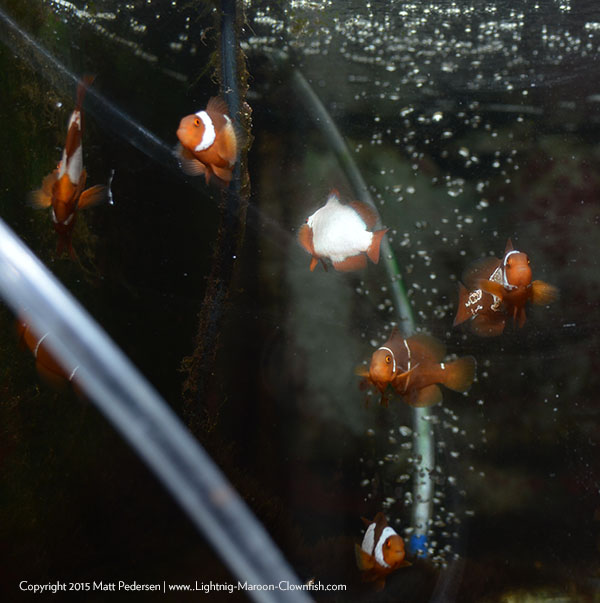
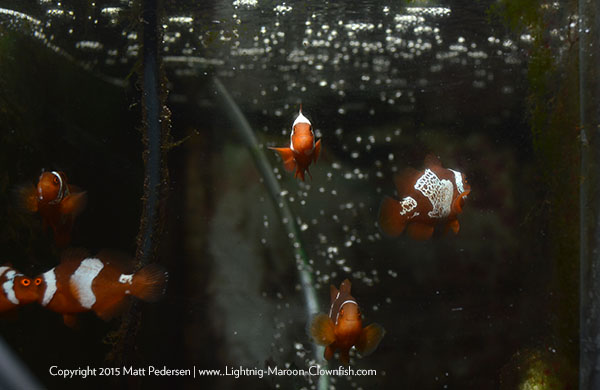
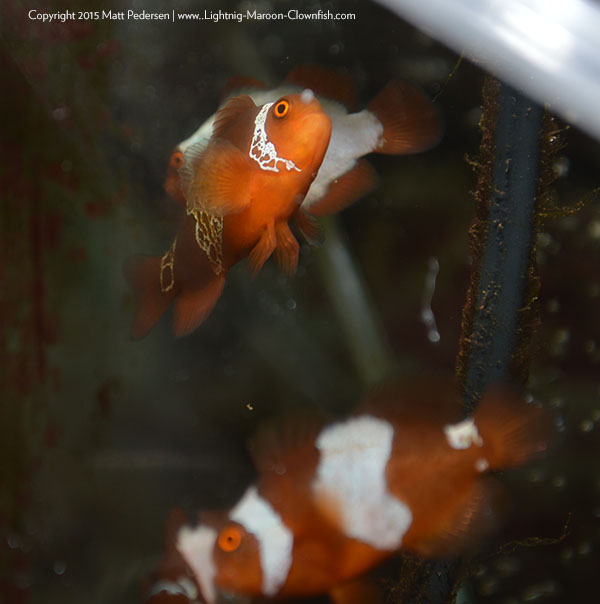
We were away from the 4th of July holiday weekend, and at some point during our absence, the F1 Lightning X Lightning pair put down Spawn #15. I’m going to guess that it was on the 3rd; it’s now the night of 7-10 going into 7-11, and there are just a few unhatched offspring left at 2:45 AM.
Yes, when you’re not actively rearing any spawns (due to a planned fishroom redesign) tracking them seems to fall out of priority rather quickly. That said, it’s a habit I should stick to, even if it makes for rather mundane blog updates! Gotta record the data.
Wednesday, June 24th, the F1 Lightning X Lightning pair spawned, putting down what is now their 14th spawn. For whatever reason, they’re taking a slower incubation period…most of the eggs hatched 7 days later, the following Wednesday night, July 1st going into today. Roughly 1/3 of the nest remains…and presumably will hatch tonight. I should point out that the pair is currently receiving no foods other than Spectrum’s Thera A, and has been on such a diet for quite a while. I’m pretty impressed with the nests I’m seeing from fish eating only pellet foods!
The F0 (wild) Lightning Maroon and White Stripe spawned this week again, spawning on Tuesday, June 30th. Based on my records this is their 59th spawn. Crazy to think about.


Recent Comments